The Philippines is looking at more joint exercises in the South China Sea and beyond

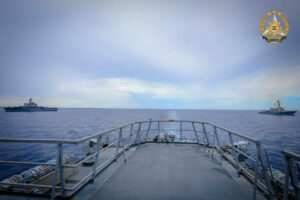
THE Philippine military plans to hold more joint naval exercises with its allies in the South China Sea and beyond as it expects the Chinese to become more assertive in the waters of conflict, a navy spokesman said on Tuesday.
The Philippine military is planning to expand naval exercises beyond its traditional allies to strengthen the blockade as Manila faces increasing Chinese tensions and may also hold similar exercises across the South China Sea, said Rear Admiral Roy Vincent T. Trinidad, a spokesman for the South China Sea navy.
“There will be an increase in participation in many countries… [and] there will be an increase in our dialogue with many nations,” he said in a press conference.
Beijing claims almost all of the South China Sea under its “nine-dash line” map and has deployed naval forces near the disputed areas, leading to maritime disputes as the Philippines pushes back against growing Chinese claims.
A United Nations-backed arbitration court ruled in 2016 that China’s claim was illegal, a decision Beijing rejected.
The Philippines has stepped up efforts to counter Beijing’s maritime claims by expanding alliances beyond the US, its longtime treaty partner. Manila has also increased what it calls joint maritime operations with other allies to counter China’s growing presence, which it sees as a threat to regional security.
Mr. Trinidad said the military will plan where to hold its exercises based on the country’s security situation. “These tests that have been done will adequately respond to the dynamics of the region.”
He added that the Philippine military expects China to continue deepening its naval integration to increase Chinese control over disputed features in the South China Sea.
The statement of Mr. Trinidad follows the release of a report by the Philippine Navy, which found that Beijing has increased its enforcement in disputed waters by changing their deployment patterns.
China’s navy and coast guard have increased cooperation in their deployments, complementing each other’s presence in an effort to increase control over contested waters.
The Philippine Navy recorded a total of 447 Chinese naval vessels and military vessels deployed in the South China Sea, including areas within the Philippine economic zone only. This is up from the 278 ships seen in 2024.
The report also noted that the presence of the People’s Liberation Army Navy (PLA-N) in 2025 was also consistent, predictable, and geographically close to contested areas.
The Navy’s report also noted the increased presence of PLA-N, China’s coast guard and navy following almost all Naval Cooperation Operations in the Philippines conducted with its allies and partners.
“We expect this trend to continue, not only in the sea, but even in the air,” said Mr.
Beijing has rejected a report by the Philippine Navy that said China has increased its aggressive behavior in the South China Sea, according to the Chinese Embassy in Manila.
“It is full of misconceptions and biases about China, slanders China’s military actions, distorts China’s position on the South China Sea issue and deliberately misleads the public,” the Embassy said in a statement on Tuesday.
The Chinese embassy said it follows a defense policy that is “defensive and pursues a military strategy of effective defense,” aimed at protecting its national sovereignty, security and development interests.
It added that Beijing’s military has acted in accordance with domestic and international law and has been protecting its rights and interests in a fair, reasonable, and deterrent manner.
“The Philippines has deliberately de-escalated and routinely engaged in large-scale military engagements with non-regional countries,” it added.
FALSE REBATE
Meanwhile, Mr. Trinidad disputed a report by China’s natural resources ministry that accused the Philippines of damaging the Scarborough Shoal ecosystem as Beijing eyes “stronger protection measures” there.
“Historically, it was the agents of the Chinese Communist Party who were on record doing damage and destruction of the environment,” he said.
China’s embassy in Manila did not immediately respond to a Viber message seeking comment.
Manila and Beijing both claim the Scarborough Shoal, well known for its rich ecosystem and proximity to major shipping lanes. The 2016 ruling said China had caused significant damage to Scarborough’s coral reefs.
The Chinese report said the “illegal fishing and logging activities” by the Philippines have undermined the ecosystem of the island.
“All these are false stories that we do not accept,” said Mr.
In September, China approved the creation of a 3,500-hectare reserve along the northeastern edge of Scarborough Shoal, which it says is aimed at preserving biodiversity in one of the waterway’s most contested areas. Manila called the plan “a clear excuse for occupation.” – Kenneth Christiane L. Basilio with Adrian H. Halili