Philippines: Chinese ships harassed a fishing boat near Scarborough Shoal

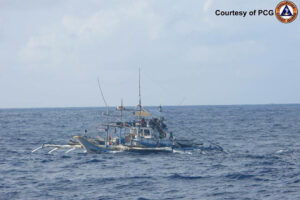
A Philippine fishing vessel was attacked by Chinese military and coast guard vessels near the disputed Scarborough Shoal on Monday, highlighting tensions in the South China Sea as Beijing asserts tighter control over the disputed waters.
A People’s Liberation Army Navy vessel with bow number 621 and a Chinese Coast Guard vessel approached a fishing boat nearby, at a distance of 30 meters, while sounding their sirens in an apparent attempt to block the route to fishing grounds in the west of the coast, the Philippine Coast Guard (PCG) said in a statement on Tuesday.
The captain of the boat swerved to the southeast to avoid the ships but was reportedly being closely followed by a Chinese Coast Guard vessel.
PCG deployed a multirole vessel BRP Cape San Augustproviding a diesel fishing boat, allowing it to continue working and heading for Scarborough Shoal.
China’s embassy in Manila did not immediately respond to a request for comment.
Scarborough Shoal, known locally as Panatag, is claimed by the Philippines and China. It is known for its rich marine resources and strategic location along important shipping lanes.
China took control of the shoal in 2012 after a dispute with Philippine forces, and since then has maintained a presence with coast guard ships and fishing vessels, preventing access to Filipinos despite a 2016 United Nations-backed arbitral ruling that confirmed the area as a traditional Philippine fishing ground.
Rear Admiral Roy Vincent T. Trinidad, a Philippine Navy spokesman, described the incident as part of China’s “coercive and violent actions” aimed at discouraging Filipino fishermen. “These actions are designed to destroy our fishermen’s desire to fish,” he said in a press conference.
Admiral Ronnie Gil L. Gavan, PCG commander, said the coast guard will continue to protect Filipino fishermen. “We remain steadfast in protecting the safety and maritime rights of our fishermen, in full compliance with the United Nations Convention on the Law of the Sea (UNCLOS),” he said in a statement.
Mr. Trinidad said the Philippine Navy monitored 41 Chinese vessels in all four areas of conflict during the first week of January.
At Scarborough Shoal, the navy spotted two Chinese warships, three coast guard vessels and three navy boats.
At Second Thomas Shoal, six coast guard vessels and eight naval vessels were sighted. In Sabina Shoal, there were three warships, six coast guard ships, and four military boats, while in Thitu Island, there were four coast guard and two military ships.
He noted that while China’s presence is important, it remains within the normal range monitored by Manila.
“They are not threatening yet … these numbers are still in the normal range that we are following,” he said. He predicted that activity in 2026 will increase, reflecting the trend of increasing Chinese exports along with the disputed features.
The Philippine National Maritime Council on Monday accused China of “persistent illegal, coercive, cruel and deceptive activities” in Philippine waters.
“Filipino fishermen are legitimate citizens pursuing their livelihoods,” the council said. “Protecting them is the duty of the state, not an act of escalation.”
In response, Beijing accused Manila of stoking tensions. Deputy Spokesman Wei Guo said the Philippines “continually creates problems in an attempt to change the status quo,” misrepresenting China’s activities as illegal.
He rejected the Philippine concept of “marine zone,” noting that UNCLOS only recognizes maritime zones and exclusive economic zones (EEZ).
“For a long time, the Philippines has deliberately blurred the distinction between the territorial sea and the EEZ, and misrepresented China’s normal activities in the EEZ waters claimed by both countries as ‘illegal patrols,'” said Mr. Wei.
He added that China worked to protect its sovereignty while holding back and remains open to dialogue with Manila.
Brunei, Indonesia, Malaysia and Vietnam also have applications for parts of the important waterway. Despite a 2016 UN-backed resolution rejecting China’s claim, Beijing has continued to expand its presence in the sea, sometimes leading to confrontations at sea.
Manila has strengthened maritime cooperation with allies and introduced programs to support its fishermen, including subsidies for fuel, food and equipment to encourage their presence in the disputed waters.
Officials say the measures are necessary to preserve the Philippines’ fishing rights and prevent Chinese encroachment while maintaining security in the strategic waterway. – Kenneth Christiane L. Basilio again Adrian H. Halili