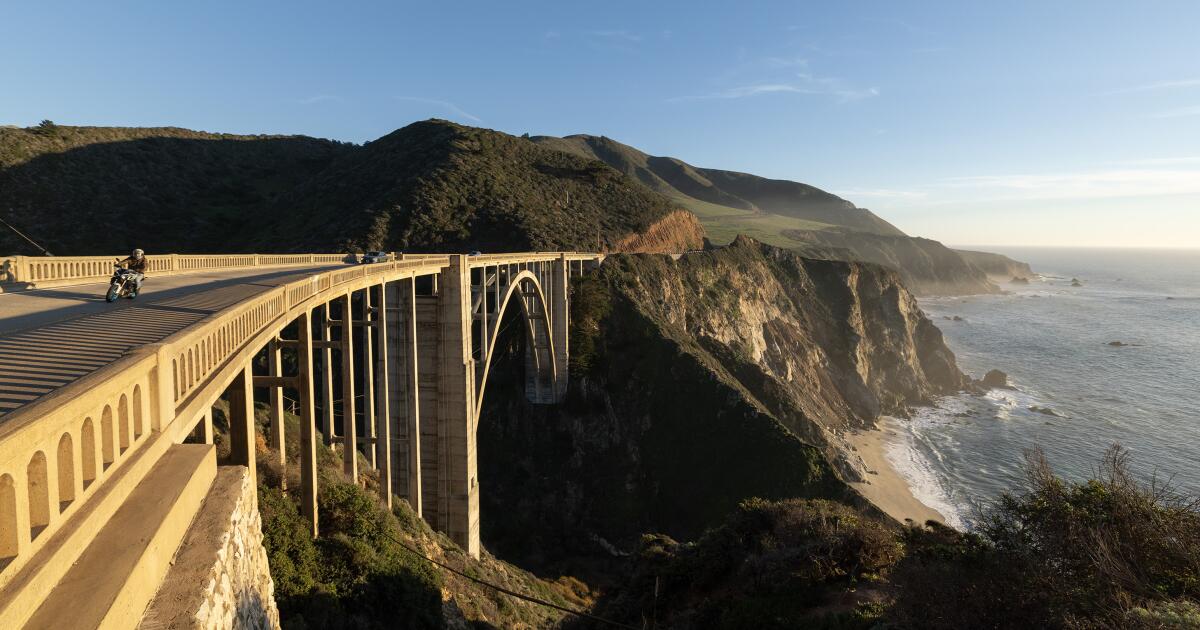
California marked a milestone this month with the return of uninterrupted Highway 1 to the dangerous, yet spectacular cliffs of Big Sur.
The famed coastal road was closed for more than three years after two massive landslides buried the two-lane highway, and it took unprecedented engineering effort and hazardous debris removal to reconnect northern Big Sur with its southern neighbors.
But no one expects this to be the end of Highway 1’s battle with nature’s forces, especially in a world facing the severe effects of human-caused climate change.
“We, in Big Sur, know how to plan with a grain of salt,” said Matt Glazer, executive director of Deetjen’s Big Sur Inn, which is near the northern end of the closure. “This is a snapshot of time, and the ever-changing coastline of Big Sur is what makes it beautiful.”
Turbulent weather has always been the enemy of the glory of Highway 1. The coastal road has been closed due to rockslides, mudslides, floods, wildfires and coastal erosion, especially in Big Sur but also in several sections from Malibu up through the North Coast.
But this latest closure — seen as the longest in Highway 1’s 90-year history — is raising new questions about how the highway can survive amid strong and unpredictable storms, seas and fires.
“If our storm and other conditions were normal, we would expect closures and losses at the same time,” said Michael Beck, director of UC Santa Cruz’s Center for Coastal Climate Resilience. “The challenge is that we are now clear that the events that will have an impact – these very dangerous events – are increasing exponentially. … Climate change is here and now, it is no longer a problem of the future.”
And those intensifying weather conditions – high, strong tides that accelerate erosion; wet, fluctuating atmospheric river storms that cause landslides; and the hottest, most destructive fires that create conditions ripe for mudslides — affecting much of the 650-mile stretch of highway from southern Orange County to Mendocino County.
But the combination of these climate problems is especially visible in Big Sur, where waves, storms and wildfires regularly affect its steep and fragile landscape, which is made up of a “melange” of rock types that are vulnerable to change, said Jonathan Warrick, a US Geological Survey geologist at the Pacific Coastal and Marine Science Center in Santa Cruz.
“We have low tides [the cliffs] … and then we get heavy rains that give the lubrication to these things to break down and fail,” Warrick said. “And then we have wildfires, and when that happens, we can often have debris coming down these mountains.”
Glazer said he can’t remember a so-called normal year in Big Sur — without highway closures, dangerous wildfires or damaging floods — since before 2015.
The past decade has been marked by turmoil in the region from massive wildfires that have forced people to evacuate and destroyed homes, leaving burn scars that cause hazardous waste flows. Most notably in 2017, heavy rains created a series of emergencies: first the failure of the Pfeiffer Canyon Bridge and a massive landslide near Mud Creek that left residents without work for months as the California Department of Transportation worked on repairs in 2019. Then, storms in the winter of 2022-23 caused two major roadway collapses. three-year closure.
“That’s 11 years of something happening,” Glazer said. “There is no doubt that climate change and its impact on the environment are contributing to the speed and severity of changes. … Climate resilience must be part of the conversation.”
And while California has continued to lead many of the nation’s discussions and efforts related to climate change mitigation, specifics about how it is preparing for and responding to problems across Big Sur and Highway 1 remain unclear.
Caltrans, the agency tasked with maintaining Highway 1, has spent millions annually on such efforts, most notably an estimated $162 million in four maintenance and rehabilitation projects through January 2023, according to agency spokesman Kevin Drabinski. But he did not respond to questions from The Times about planning for a major climate resilience facility for Big Sur and the rest of Highway 1.
Storms, mudslides and landslides also often cause temporary closures in the Malibu area, where the road is often called the Pacific Coast Highway, adding to a long list of costly and inefficient highway repairs.
“It needs a lot of maintenance and it will continue to need a lot of maintenance,” Warrick said. The future of Highway 1 “is engineering and politics and finance will question more than anything.”
Like clockwork, road failures and landslides often bring questions about when, or if, it might make sense to abandon or rehabilitate sections of highway 1. When is it most expensive to maintain? Or is there a way to convert it, perhaps into a paid form that would moderate its exposure and help cover its rising costs?
In a few rare cases, officials have made major changes to the highway, including a tunnel that in 2013 replaced a treacherous road known as the Devil’s Slide south of Pacifica. And to the north near Gleason Beach in Sonoma County, rapid erosion forced officials in 2020 to move part of the road inland, to avoid the wrath of the sea.
But, for the most part, in California the focus has been on fixing existing infrastructure, Beck said.
“We’re going to need to get creative with solutions, including how we pay for them,” Beck said. “We can’t just hold on to the past.”
“We have to do more to accept, even progress, in the new future,” he added.
While parts of California’s geography, geology and meteorology make conditions unique to Highway 1, Beck said, dangerous — and deteriorating — coastal highways are a common problem around the world. While there likely won’t be a single solution, he sees opportunities to make improvements on a continuum – from resistance to restructuring – including market-based solutions, such as improving the way risk is priced, and nature-based solutions, such as reinforcing dunes and wetlands, which can help mitigate erosion.
But for locals, keeping the road open and in place remains a priority, even in the face of climate change.
“There’s a sense that things could be very difficult in the next 10, 20 years,” said Ryne Leuzinger, chairman of the board of directors of the Big Sur Community Assn., which works to increase fundraising to better prepare for the next disaster. “If the situation is difficult in some way … the community will be there to help each other.”
The key, he said, is “a consensus on the importance of Highway 1,” something he continues to hear from California leaders, who view Highway 1 as a global tourist attraction and driver of local and national business.
While Glazer would like to see officials focus more on prevention and quick work to stabilize the area, rather than active repairs, he said there is no doubt in his mind that the road should be maintained in good condition.
“Come drive the road and it will answer your question,” Glazer said. “It’s always changing and elements will evolve and engineering will change, but it’s National Scenic. [Byway] for a reason.”
Gregory Hawthorne, owner of the Hawthorne Gallery in Big Sur, does not want to return to the “island” life as they experienced in 2017, or the cul-de-sac of the past three years, but he also knows that sometimes the price you pay for living in this beautiful region.
“Sometimes when you live on the edge, the edge falls off,” said Hawthorne, 74. “The benefits outweigh the disasters or the different things that happen. … You have to be tough to stay in Big Sur.”