By Justine Irish D. Tabile, Senior Journalist
Rail projects funded by the Japan International Cooperation Agency (JICA) are on track for completion despite the potential impact of the Middle East war on oil prices and costs, contractors say.
“Although we are facing various challenges, including the conflict in the Middle East, we will achieve our goal,” said Takashi Date, project manager of the Metro Manila Subway Project (MMSP) Contract Package (CP) 103 during a press visit by the Embassy of Japan in the Philippines.
MMSP CP103 Construction Manager Ricky P. Salenga said the increase in oil prices is a concern as the contractor, Sumitomo Mitsui Construction Co., Ltd., uses fuel for heavy machinery.
“Since this is a construction project and we use heavy machinery, it requires a lot of oil. Therefore, (the limited supply of) oil can affect us,” he said.
He said the delay will only happen if there is no oil.
The recent increase in oil prices has affected the cost of this project.
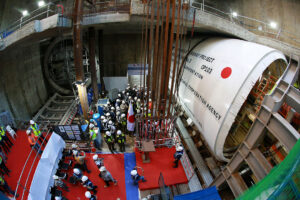
The MMSP is 6.516 kilometers long and includes two underground stations – Anonas and Camp Aguinaldo – and tunnels.
As of March 21, the MMSP CP103 package has a completion rate of 28.43%. The subway is expected to be completed by 2032.
A joint venture between Shimizu Corp., Fujita Corp., Takenaka Civil Engineering & Construction Co., Ltd., and EEI Corp. (SFTE) also expressed confidence in completing MMSP CP101 on time to complete the mission.
So far, the jobs under CP101 are about 52%. The contract covers the 30.7-hectare Ugong depot and MMSP Valenzuela, Quirino Highway, Tandang Sora, and North Avenue stations.
However, Antonio M. Aganon, Jr., deputy public station manager of the joint venture, said the company has made plans for all the things the project will need in advance.
“It will affect the final cost of this project,” he said. “But no one really knew when (the war) would take place. So, all we can do is stick to our plan.”
So far, the company has already imported most of the equipment and expects the tunnel boring machines to be delivered in the next two weeks, said Mr Aganon.
MMSP CP101 also covers the construction of the Philippine Railway Institute, which is expected to be completed within the year.
Meanwhile, Taisei-DM Consunji, Inc. Joint Venture (Taisei-DMCI JV), the contractor behind the North-South Commuter Railway (NSCR) CP01, said it is seeing an increase in the prices of oil and construction materials affecting the project.
“We are now in the phase of finishing the stations and some of the buildings here. So, the only impact for us is probably the increase in the price of fuel or the cost of other things that will be increased,” said Gerardo S. Ancheta, Jr., deputy project manager of the Taisei-DMCI JV.
He said the war may have an impact on the prices of items that the company has not yet bought from other countries.
“We are coordinating that very well with the manufacturers and suppliers we have … At the moment, we have not heard any problems or issues from them,” he added.
Regarding the JV part of the project, he said the company is on track to complete its part by the end of the year.
“However, there are some tasks that we have to work on with CP04,” he added, noting that the company will not be able to complete these facilities without electrical and mechanical (E&M) systems and track works from CP04.
Mr. Ancheta said the delay was due to the late award of CP104, as it was awarded only three years after CP01.
As of March 11, the overall progress of NSCR CP01 is 88.77%. Partial operation of the NSCR is expected in 2027.
To ensure the timely completion of the two railway projects, President Ferdinand R. Marcos, Jr. ordered the release of P44.17 billion to the Department of Transportation (DoTr).
According to the Department of Budget and Management (DBM), the funding will “address critical borrowing needs—ensuring that construction timelines remain on track and momentum is sustained.”
“The funding was approved through Special Allotment Release Orders (SAROs) approved by DBM Secretary Rolando “Rolly” U. Toledo on March 23.
The release was charged against unplanned budgets under the 2026 General Appropriations Act, specifically Support to Foreign-Assisted Projects (SFAPs).