By Erika Mae P. Sinaking
THE unemployment rate in the Philippines rose sharply year-on-year in November 2025 despite the start of the holiday hiring season, as bad weather and job losses in key industries exceeded the normal average for the fourth quarter, data from the Philippine Statistics Authority (PSA) showed.
Preliminary results of the Labor Force Survey (LFS) put the unemployment rate at 4.4% in November, up from 3.2% last year, although it was below 5% in October. This translated to about 2.25 million Filipinos unemployed, compared to 1.66 million in November 2024 and 2.54 million last month.
Labor Secretary Bienvenido E. Laguesma said the November figures were unexpected given the seasonal pattern of strong employment towards the end of the year.
“Yes, I am surprised because, as you said, the ‘man’ months are related to additional employment. Note, however, that the November 2025 figures are better than the October 2025 figures which indicate a recovery,” he told BusinessWorld.
National Statistician and PSA Executive Secretary Claire Dennis S. Mapa said the year-on-year weakness in the labor market reflects weather-related disruptions and job losses in several major sectors.
“[There were] two major storms in November last year, including Tinio, and their impact is widespread,” he said at a press conference on Wednesday.
In the first 11 months of 2025, the unemployment rate reached 4.19%, above the 3.9% average recorded for the same period in 2024.
Employment data for November also showed mixed signs. The number of employed Filipinos rose to 49.26 million in November from 48.62 million in October, indicating some seasonal recovery.
However, employment remained below the 49.54 million recorded in November 2024, underscoring the continuing effects of the disruption at the beginning of the year.
As a result, the employment rate dropped to 95.6% in November from 96.8% last year, although it was slightly better than the 95% in October.
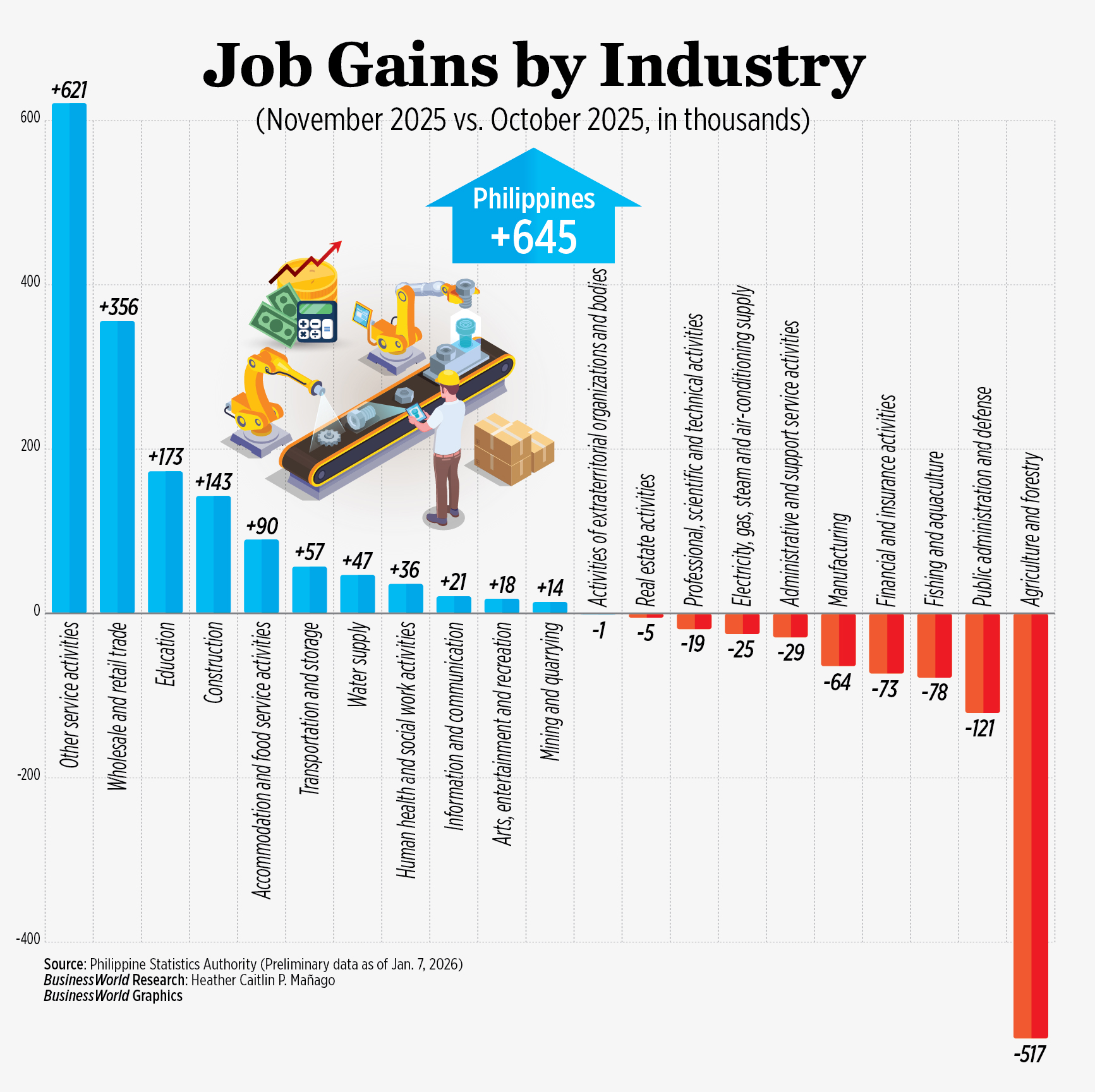
Mr. Mapa said that general employment growth during the “ber months” was weaker than expected. He mentioned that 49.26 million people are employed in November 2025, 277,000 less than the previous year.
The impact was most visible in sectors sensitive to mobility, such as tourism and travel.
The average employment rate for the first 11 months of 2025 stands at 95.8%, lower than the level recorded in the comparable period in 2024.
NOT WORKING
Data from the PSA showed the unemployment rate fell to 10.4% in November from 10.8% in November 2024 and 12% in October. This was the lowest unemployment rate in nine months or since 10.1% in February.
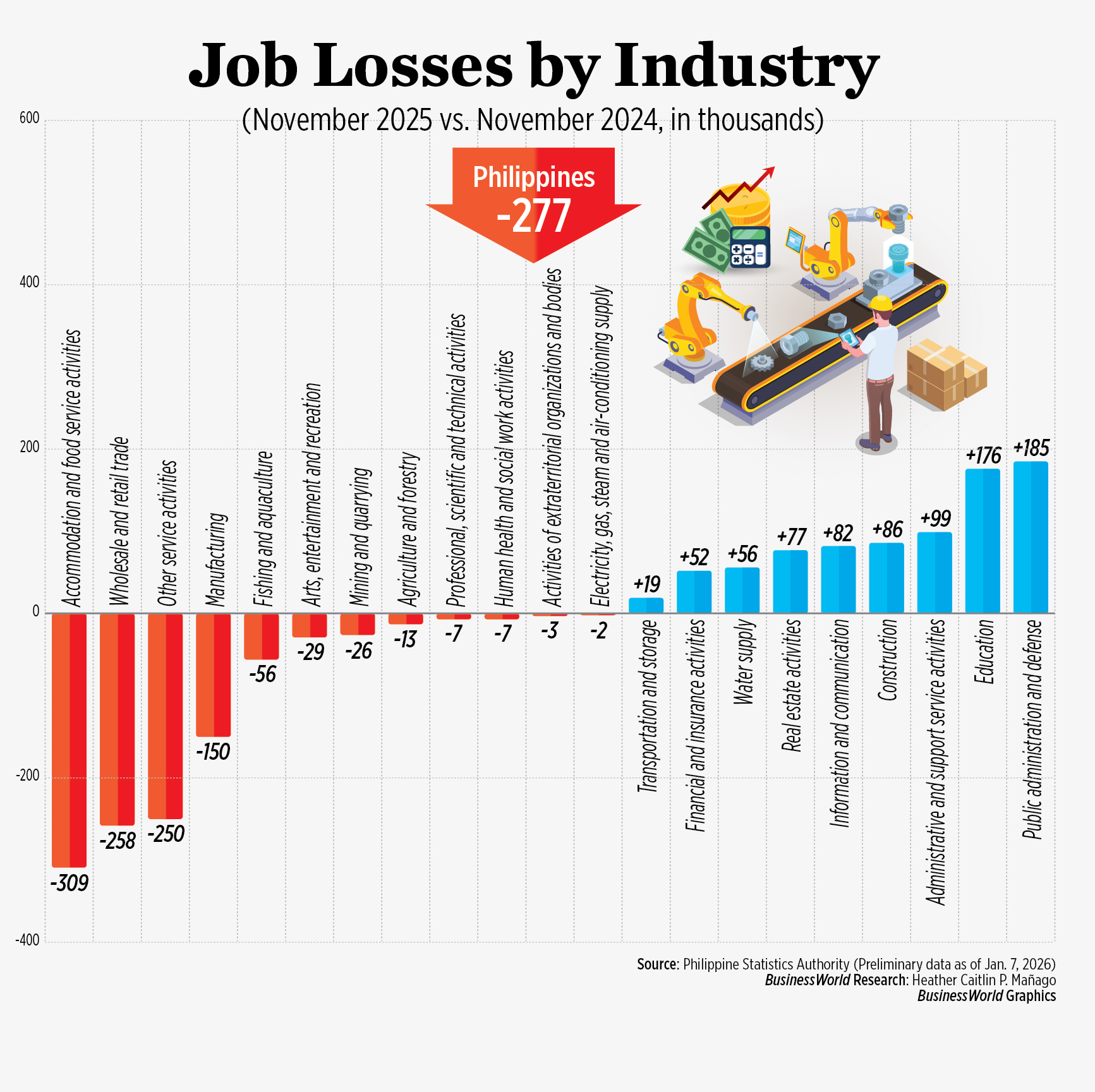
The number of unemployed Filipinos – those looking for longer working hours or more work – fell to 5.11 million in November from 5.35 million last year and 5.81 million in October.
Year to date, the unemployment rate stands at 12.26%, up from 12% last year.
The employee engagement rate increased to 64% in November from 63.6% in October but fell from 64.6% last year. This translates to 51.52 million workers in November, over 51.16 million in October and 51.2 million in November 2024.
PSA data showed job losses were concentrated in industries directly affected by bad weather and weak consumer activity in November.
Accommodation and food service jobs had the largest year-over-year decline, shedding 309,000 jobs. Losses were concentrated in restaurants and mobile food service jobs, which cut 191,000 positions, followed by short-term jobs with a decrease of 76,000 jobs, and event catering services, which decreased by 23,000.
Wholesale and retail trade, including auto and motorcycle repair, also lost 258,000 jobs year over year.
The decline in employment was also recorded in retail sales and markets selling food, beverages, and tobacco, as well as consumer goods and auto sales. Other service jobs are shedding 250,000 jobs, driven largely by cuts in personal health services and home services.
Manufacturing jobs fell by 150,000, reflecting continued weakness in the sector. Mr. Mapa said the semiconductor and electronics sector, in particular, lost 106,000 jobs year-over-year in November.
He said the production of other food products and the processing and storage of fruits and vegetables also posted significant job losses, due to supply chain disruptions and reduced working days following the typhoons.
“These sectors – accommodation and food service activities, wholesale and retail trade, other service activities, and manufacturing – contributed to the decline in the number of employed people, which resulted in higher unemployment year after year,” said Mr Mapa.
Other sectors, however, recorded employment gains. Public administration and defense, including mandatory social security, added 185,000 jobs year over year, while education employment increased by 176,000, partly reflecting continued employment in government and public institutions.
IS DECEMBER BETTER?
Michael L. Ricafort, chief economist at Rizal Commercial Banking Corp., told BusinessWorld that the high unemployment rate in November was “partly due to a series of storms, typhoons, floods that caused weather-related disruptions that reduced business days, sales, income of some businesses, consumers, and other institutions.”
In a Chinabank study, the decline in manufacturing activity, particularly in the production of semiconductors and other electronic components, reflected the impact of recent storms on business performance.
“Looking ahead, the sector continues to face the risks of a challenging external environment, although domestic demand can help support factory activity and improve job opportunities,” he said.
Chinabank Research said it expects holiday demand in December to support employment and spending by the end of 2025.
“December may show better data with stronger demand driven by the holidays, although this seasonal growth will slow down this month. This year, we expect the labor market to remain strong and support a recovery in consumption growth,” it added.
Mr. Ricafort said the labor market is likely to improve in December 2025 amid high seasonal demand, better weather conditions, and increased economic activity.
“Nonetheless, the unemployment rate at 3%-4% levels is still considered the best in about 20 years or since the updated records started in 2005,” he said.
Mr. Ricafort also pointed out that the money spent by the government is scheduled to participate in 2026, focusing on governance changes and anti-corruption measures, as a way that may have an impact on investor confidence, economic growth, and employment going forward.
In a statement, the Department of Economy, Planning, and Development (DEPDev) said the latest LFS results underscore the need to strengthen labor competitiveness and business resilience amid ongoing disruptions.
“The government is prioritizing investments in skills development, lifelong learning, and social security programs so that workers can adapt to all sectors and face economic shocks. Strengthening the competitiveness of workers is one of the important factors to attract investments that produce quality jobs,” said DEPDev Secretary Arsenio M. Balisacan in a statement.
On the other hand, Mr. Laguesma said that the Ministry of Labor and Employment, in collaboration with private companies, will combine efforts to come up with “better employment results” in the coming months.