

The Philippines is intensifying efforts to find alternative sources of fuel, President Ferdinand R. Marcos, Jr. said. on Thursday, as the escalating war in the Middle East continues to threaten global oil supplies and push prices even higher.
Mr. Marcos said the government is working to “tamp down[ing] the blow” of the war, adding that it has received enough food and fuel.
“What we are monitoring now are the prices. With food, we can do more – we are looking for ways to lower food prices,” he told reporters in Filipino during an inspection in Bataan.
“As for the oil, we can’t do anything about that, but at least we’re making sure it will be available.”
He added that the government is looking for other sources of oil to ensure that the country has enough supplies, saying that the suppliers of the Philippines are committed to honoring their contracts.
“Fertilizers, fuel products, that will not be a problem because our suppliers promise to honor their contracts.”
Energy Secretary Sharon S. Garin previously said that the country is looking at other sources of oil, such as the US, Canada, Russia or South American countries, as the Middle East continues to be heavily affected by the Iran war, causing prices to rise.
In an effort to mitigate the impact, the government has previously ordered concessions on public trains, which could lead to a move to subsidize toll roads.
Mr. Marcos also blocked a planned hike in public transport fares, drawing criticism from drivers and workers who are struggling due to rising fuel prices.
“Our real goal here is to save people’s lives – so they can continue to have a way to earn a living,” he said. He explained that although he has stopped the increase in fares, the government plans to provide assistance to deal with the high costs.
“The increase in fares will be postponed, instead, we will increase the assistance they are given.”
He also said that the government is finding different ways to provide funding.
Finance Secretary Frederick D. Go earlier said he met with private oil companies over the weekend to explore more measures to diversify fuel supply by expanding the number of suppliers in the Philippines.
He mentioned that currently the country imports fuel from only four markets – South Korea, Japan, Singapore and China.
As a warning, he added that the Philippine National Oil Co.-Exploration Corp. will buy about two million barrels in the world market to build up the country’s oil stock.
TABLE OF CONTENTS
Meanwhile, the Senate on Wednesday adopted a decision to establish a temporary committee to oversee the national contingency plans to deal with the oil shock.
“It is important that the country does not falter in its efforts to deal with the emerging problem or remain locked in the working environment, but instead use a forward-looking approach and be a step forward,” reads Senate Resolution No. 350.
Senator Sherwin T. Gatchalian, as chairman of the Senate Finance Committee, will head the ad hoc committee.
“We welcome the challenge set by this committee at this critical time, and we are committed to ensuring that all relief and mitigation measures are not only adequate but also sustainable,” said Mr. Gatchalian in a statement.
The resolution recommended the creation of an interim committee named Proactive Response and Oversight for Timely and Effective Crisis Strategy tasked with evaluating federal emergency plans, including those from the executive branch, regarding the impact of the US-Israel war on Iran.
Iran’s military leadership has warned that oil could rise to $200 a barrel, as the situation escalates in the Strait of Hormuz, where disruptions have halted a key global route that carries a fifth of the world’s oil and liquefied natural gas.
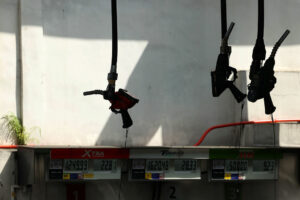
The price of gasoline increased by P12.90 to P16.60 per liter, diesel increased by P20.40 to P23.90 and kerosene increased by P6.90 to P8.90, marking the highest weekly increase this year.
Data from the Department of Energy shows that pump prices may increase to P91.60 per liter for gasoline, P114.90 for diesel and P143.79 for kerosene.
The government is now extending its cash assistance to the most vulnerable, including transport workers in the metropolitan region who started receiving P5,000 earlier this week. – Chloe Mari A. Hufana again Kaela Patricia B. Gabriel


